
Coastal Engineering
Our coastal engineering work gives communities, institutions, and property owners a clear picture of how their shoreline is behaving and a defensible set of alternatives, with costs, for protecting it.
Our approach
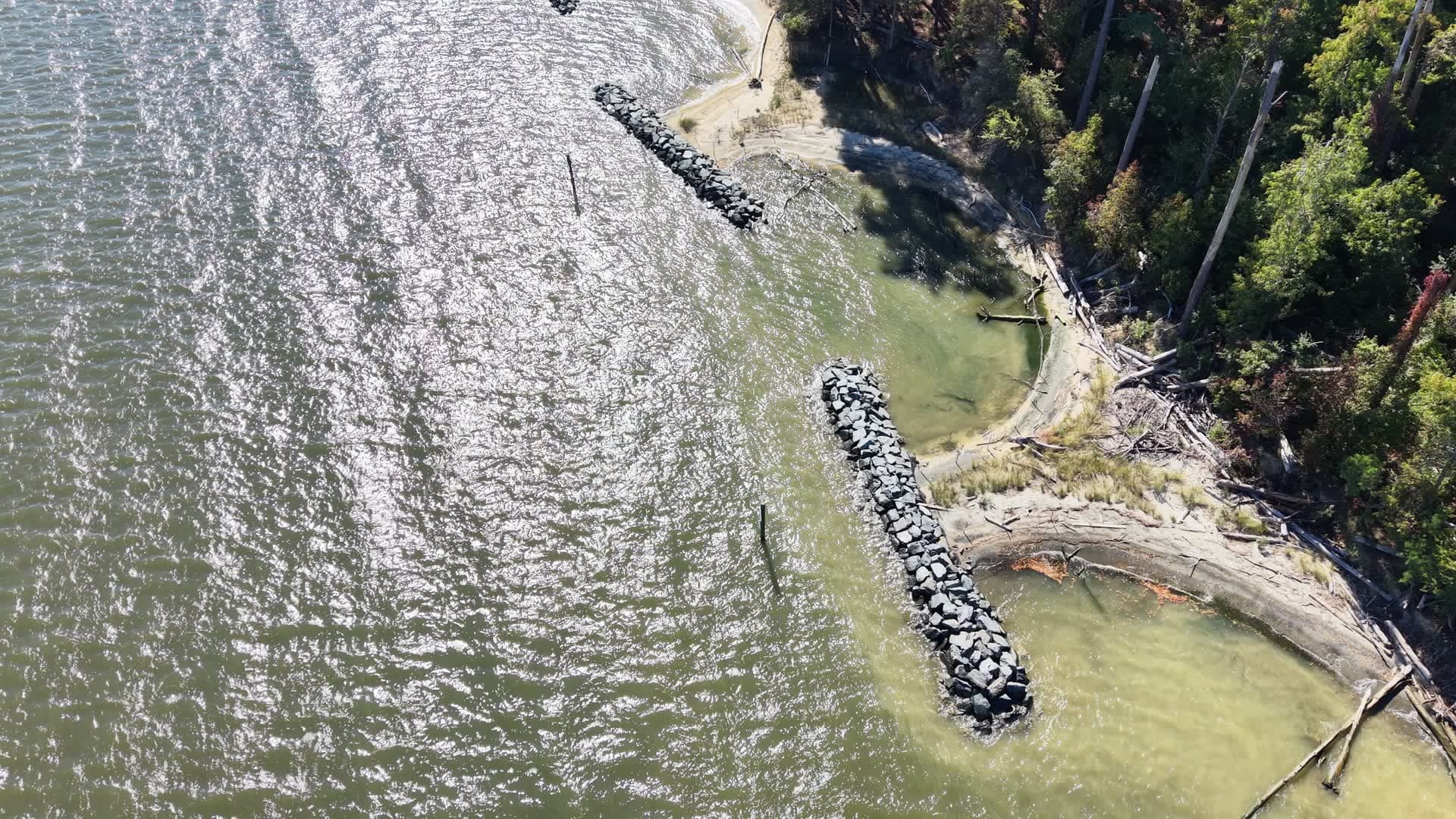
We begin with the forces on the shoreline: fetch and wind wave analysis, boat wake exposure, tidal datums, and sea-level rise projections drawn from state guidance. Nearshore bathymetry and comparison of historical imagery and past surveys quantify shoreline change and erosion rates and show where embayments and breaches are forming. With that understanding we lay out and size breakwaters, sills, headlands, and groins, set crest elevations for the design life, and compare nature-based, hybrid, and hardened alternatives on erosion protection, habitat value, regulatory feasibility, and planning-level cost. The result is a shortlist a board, a community, or an owner can act on, and a design basis that carries straight into permitting and construction plans.
Typical analyses and design considerations
- Fetch and wind wave analysis
- Boat wake exposure
- Tidal datums and water level analysis
- Sea-level rise projections and design life
- Nearshore bathymetry and topographic survey
- Shoreline change and erosion rate assessment
- Breakwater, sill, headland, and groin layout and sizing
- Crest elevation and stone sizing
- Alternatives analysis with habitat and regulatory screening
- Planning-level and construction cost estimates
Project applications
Shoreline vulnerability studies, alternatives analyses for phased shoreline projects, breakwater and sill design, and engineering support for community associations, campuses, conservation organizations, and waterfront owners.
Related services - Often paired with this work.
Restoration and resiliency projects rarely involve a single service. These are the services we most often deliver alongside this one.
- Shoreline Restoration. Living shorelines and hybrid stabilization that stop erosion with breakwaters, sills, sand fill, and planted tidal marsh instead of hardened bank. Learn more →
- Beneficial Use of Dredged Material. Putting dredged sediment to work rebuilding tidal marsh, shorelines, and islands through thin-layer placement and containment design. Learn more →
- Permitting & Regulatory Coordination. Pre-application meetings, Joint Permit Applications, MDE and USACE authorizations, and county approvals handled alongside the design. Learn more →
Have a project in mind?
Contact Sustainable Science, LLC to discuss how we can support planning, permitting, design, and construction.